⚠️ DISCLAIMER: Ministry of Cyber Affairs is an independent news, guides and directory service on cybercrime and cybersecurity, for victims and investigators. It is NOT an official government or ministry portal.
Website Scam CheckerNew
Back to News

Rising crypto drainer scams targeting Trust wallet users : Warns I4C, Ministry of Home Affairs, India
Share
Rising crypto drainer scams targeting Trust wallet users : Warns I4C, Ministry of Home Affairs, India

The National Cybercrime Threat Analytics Unit has issued an advisory regarding a rise in cryptocurrency frauds targeting Trust Wallet users, where attackers use social engineering and fake verification sites to drain digital assets.

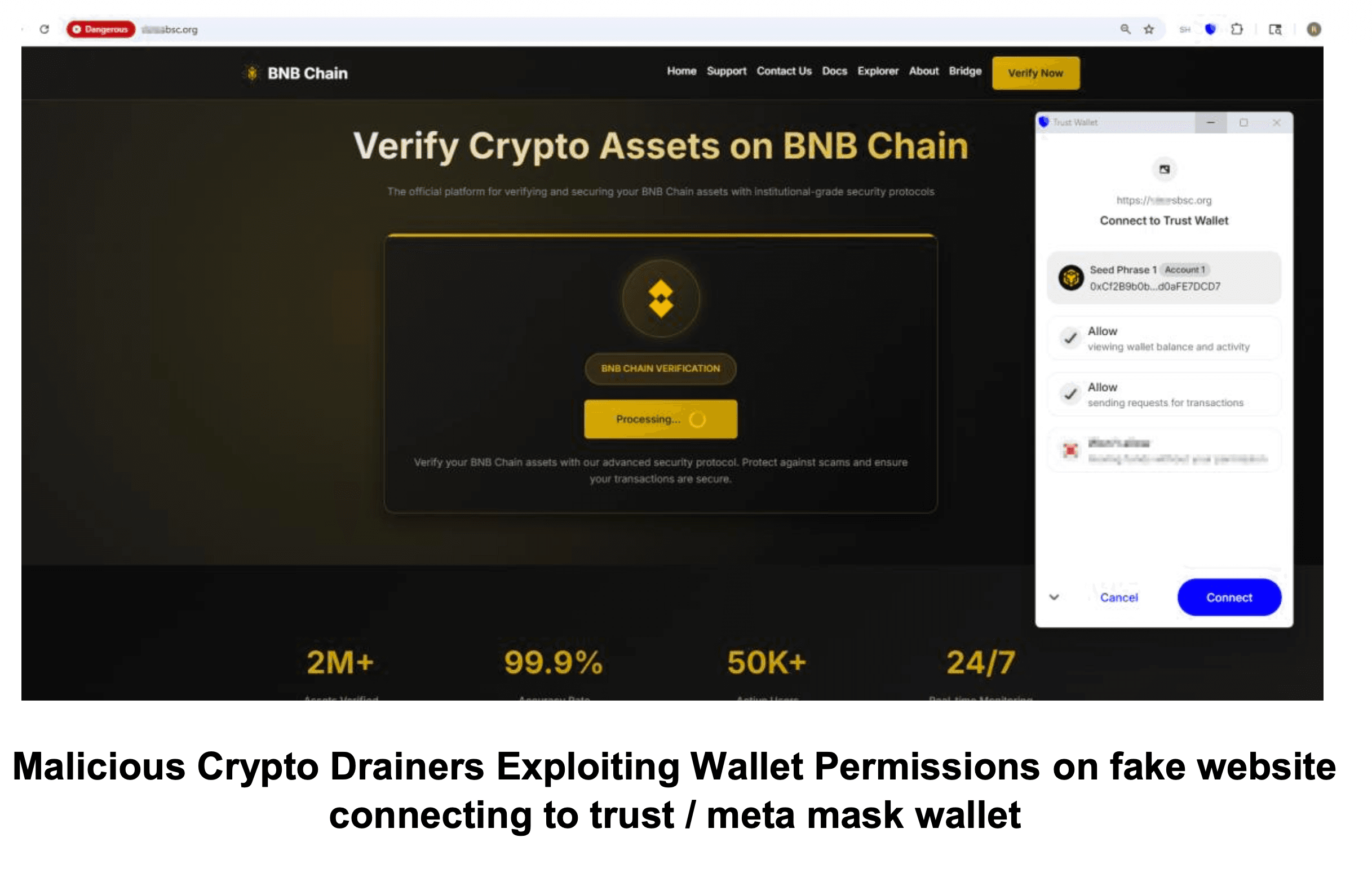
The National Cybercrime Threat Analytics Unit (NCTAU) of the Indian Cyber Crime Coordination Centre (I4C) has identified a trend in cryptocurrency fraud. Attackers typically initiate contact through P2P platforms like Binance before moving communication to encrypted apps like WhatsApp or Telegram. The scam involves informing victims that a fake crypto asset verification is mandatory. Users are then directed to fraudulent websites where they are prompted to connect their Trust Wallet. Malicious links or scripts then gain smart contract permissions, allowing perpetrators to automatically drain assets from the victim's wallet. The impact is a direct and irreversible financial loss.

How to Prevent?

To prevent this, users are advised to verify website authenticity, disconnect unknown dApps from their wallet settings, never share seed phrases, and pay close attention to critical risk alerts displayed by the wallet application. Incidents should be reported to the National Cyber Crime Reporting Portal at https://cybercrime.gov.in or by calling 1930.

Been targeted or lost money? Acting in the first hour matters most — see our step-by-step guides on how to report cybercrime and recover your money, by country. In India, call 1930 or file at cybercrime.gov.in.

Sources

More in Cybersecurity

Related articles

Cybersecurity

OpenAI Disclosed ChatGPT User Content, Including Prompts and Files, in 88 Government Requests

OpenAI disclosed user content, including text and files entered into or generated by its services, in response to 88 government requests in January–June 2026, covering 130 accounts. The company received 146 content requests, typically search warrants, and produced data in about 60 percent of them, plus 620 non-content requests for subscriber records. Ordinary requests more than doubled from late 2025. No country breakdown is given. U.S. national security demands totaled 250–499.

12 Nov 2026
Cybersecurity

CyberStrike AI - Detection for Defenders: Scripting, Tempo and Residue

CyberStrike is a free, open-source AI agent for offensive security that pairs any LLM with 56+ tools, including a 40,000-line Windows post-exploitation module. A source-code reading of commit a5ed1e0 (v1.1.16) shows every Windows action runs through five fixed wrappers after a hard-coded five-process capability probe, leaving default cs-* and CyberStrike* artefacts. Includes Sigma, Suricata, YARA and KQL detections and a response playbook.

4 Nov 2026
Cybersecurity

Cybersecurity Checklist in the Agentic Hacking Era

Google Threat Intelligence Group and Mandiant say threat actors are now using agentic offensive frameworks such as ARTEX and PentAGI in real intrusions, moving from first stolen account to deep access in hours, sometimes 15 minutes. With CERT-In already warning of AI-assisted payment API hijacking at Indian NBFCs and fintechs, here is a checklist built on Google's five defence layers and CERT-In's controls.

2 Nov 2026