OpenAI Disclosed ChatGPT User Content, Including Prompts and Files, in 88 Government Requests
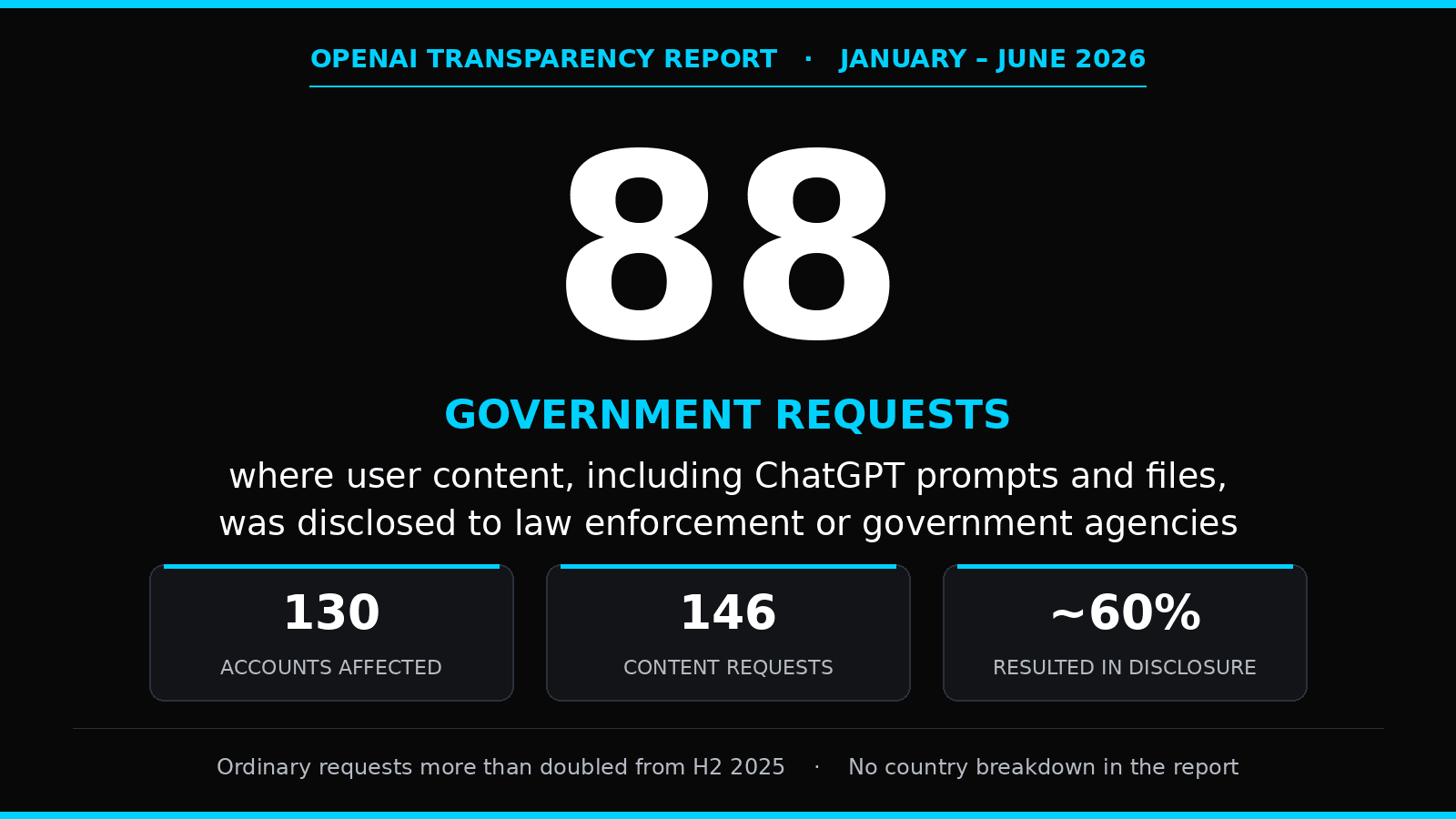
OpenAI disclosed user content, including text and files entered into or generated by its services, in response to 88 government requests in January–June 2026, covering 130 accounts. The company received 146 content requests, typically search warrants, and produced data in about 60 percent of them, plus 620 non-content requests for subscriber records. Ordinary requests more than doubled from late 2025. No country breakdown is given. U.S. national security demands totaled 250–499.
OpenAI disclosed user content, including text and files that people entered into or received from its services, such as ChatGPT prompts and outputs, in response to 88 government requests in the first half of 2026.
Those disclosures covered 130 user accounts, according to the company's transparency report for January to June 2026.
The company received 146 content requests in the period, described as legal process such as search warrants seeking "text or files input or output in connection with the use of OpenAI services."
It produced data in 88 of those cases, about 60 percent, and did not disclose data in the other 58.
The report refers to OpenAI services generally and does not name ChatGPT, but the definition covers user inputs and model outputs on those services.
Most Requests Sought Account Records, Not Conversations
Content requests were the minority.
OpenAI received 620 non-content requests, legal process such as subpoenas for an account holder's name, email address, payment information and transaction history.
It disclosed data in 441 of those requests, covering 679 accounts.
It also received 28 emergency requests, in which it may release user data if it believes disclosure is necessary to prevent death or serious physical injury.
Data was disclosed in 10 of those cases, affecting 13 accounts.
The report does not say whether emergency disclosures included conversation content.
Excluding U.S. national security process, OpenAI received 794 government and law-enforcement requests and disclosed data in 539 of them, or about 68 percent, covering 822 accounts.
Non-content requests accounted for 78.1 percent of that total, content requests 18.4 percent and emergency requests 3.5 percent.
The report does not break requests down by country, so it is not possible to identify which governments received prompt or other content data.
It also does not separately tally subpoenas, court orders and search warrants.
U.S. National Security Demands Reported Only as a Range
Requests under the U.S. Foreign Intelligence Surveillance Act (FISA) and National Security Letters are excluded from the main table and reported only in ranges required by U.S. law.
From January to June 2026, OpenAI received 250 to 499 such demands, affecting 250 to 499 accounts.
FISA orders can seek both non-content and content information.
National Security Letters are limited to information about a user's identity.
OpenAI did not say how many of these demands led to disclosure, or whether any produced prompts or other content.
Requests More Than Doubled From Late 2025
The ordinary request totals are a sharp increase from the previous six months.
In July to December 2025, OpenAI received 224 non-content requests, 75 content requests and 10 emergency requests, 309 in all, and disclosed content in 62 cases covering 84 accounts.
U.S. national security process in that period was reported in the lower 0-to-249 range.
In the first half of 2026, that figure moved into the 250-to-499 band, meaning the latest floor is higher than the previous ceiling.