Inside RBIH's EDD TechSprint - India adopting AI to solve its mule accounts issue
RBIH is bringing together innovators, regulators, and financial leaders to build solutions that are intelligent, inclusive, and ready for scale. For global builders, this is a rare opportunity to create technology that not only protects millions
The Reserve Bank Innovation Hub (RBIH), the wholly-owned innovation arm of the Reserve Bank of India (RBI), has built its reputation on one powerful idea: Innovation for Inclusion, at Population Scale.
After redefining what's possible with Swanari for women-led financial inclusion, G20 TechSprint for cross-border payments, and MuleHunter.AI™ for mule account detection, RBIH is back with its most critical challenge yet:
Introducing the EDD TechSprint
EDD TechSprint is a global innovation sprint focused on Enhanced Due Diligence (EDD).
In a world where digital payments are instant, fraud is instant too.
From synthetic identities to money mule networks, the financial system is under attack.
Traditional KYC checks are no longer enough.
We need intelligent, real-time, and explainable Due Diligence.
This TechSprint is RBIH's open call to the world's best builders to solve it.
Why EDD? Why Now?
India now processes over 18 billion digital transactions a month.
This scale is a miracle, and a target.
- The Mule Crisis: Millions of accounts are being used as pass-throughs for cybercrime. Detecting them requires behavioral intelligence, not just static rules.
- The Compliance Bottleneck: Banks spend 30-40% of onboarding time on manual EDD. It slows growth and still misses risk.
- The AI Opportunity: With 19+ behavioral patterns, graph networks, device intelligence, and generative AI, we can now do what was impossible 2 years ago: continuous, low-friction, high-assurance due diligence.
What works for India at 1.4 billion scale, works for the world.
The Challenge Tracks
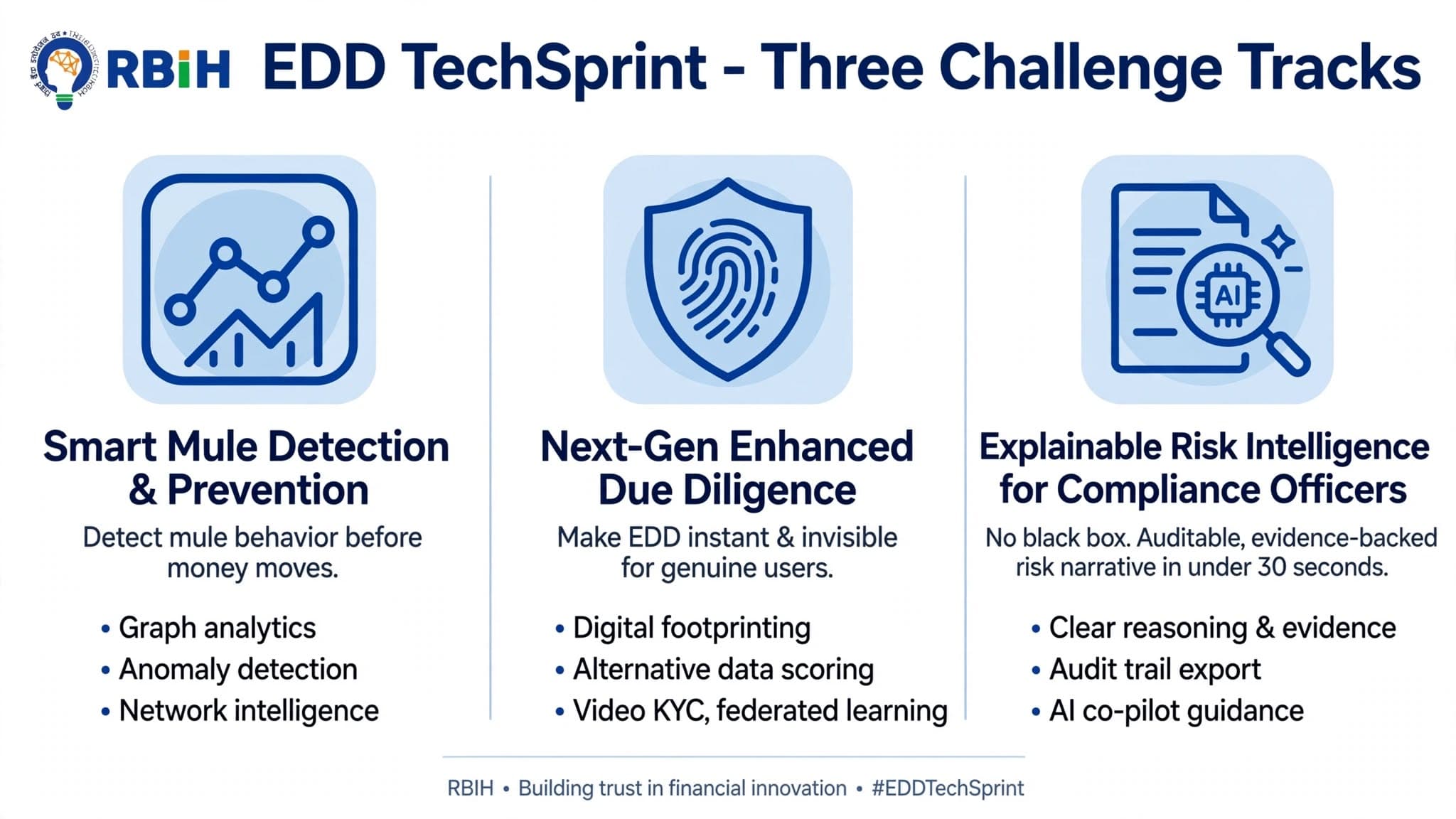
The EDD TechSprint brings together regulators, banks, fintechs, AI startups, and academia to build solutions across three core problem statements:
1. Smart Mule Detection & Prevention Beyond transaction monitoring, can you build an AI ensemble that detects mule behavior before the money moves? Think graph analytics, anomaly detection, and network intelligence.
2. Next-Gen Enhanced Due Diligence How do we make EDD instant and invisible for genuine users, but impenetrable for fraudsters? We are looking for digital foot-printing, alternative data risk scoring, video KYC intelligence, and privacy-preserving federated learning models.
3. Explainable Risk Intelligence for Compliance Officers Regulators don't need a black box. They need an auditable, explainable decision. Build the copilot that gives a compliance officer a clear, evidence-backed risk narrative in under 30 seconds.
Why Global Innovators Should Build Here
This isn't just another hackathon.
This is a pathway to deployment in the world's largest digital finance ecosystem.
For Startups & Fintechs:
- Scale-up Partner Access: Direct mentorship and pilot opportunity with leading Indian Banks and RBIH's ecosystem. Previous TechSprint winners have partnered with Federal Bank, HDFC, and others.
- Build with the Best Data: Access to RBIH's sandbox environment, synthetic datasets, and expert guidance on MuleHunter.AI™ patterns.
- Regulatory Visibility: Showcase your solution directly to the Reserve Bank of India and a cohort of 13+ global regulators who collaborate with RBIH.
For Global Tech & AI Labs:
Test your graph neural networks, LLMs, and fraud models on a real-world, high-velocity problem set that no synthetic Kaggle dataset can replicate.
Prizes, Funding & Incubation: Winners receive incubation support from RBIH and IIMA Ventures, cloud credits, and a fast-track to commercial deployment.
Who Should Apply?
- AI/ML startups building fraud, risk, identity, or compliance tech
- Cybersecurity and RegTech companies
- University research teams and data science collectives
- Any builder who believes trust is the ultimate product
All startups into AML/CFT, KYC, transaction surveillance, identity verification, or network risk should apply.
This is Bigger Than Compliance.
Enhanced Due Diligence isn't about ticking a regulatory box.
It's about protecting a migrant worker from losing her savings.
It's about ensuring a small business owner in the North East can get a loan without friction.
It's about making sure innovation doesn't come at the cost of security.
RBIH is inviting the world to co-create the trust layer for the next billion.
Applications are now open at edd-techsprint.rbihub.in
Are you ready to build for resilience?
About RBIH
Reserve Bank Innovation Hub (RBIH) is a wholly-owned subsidiary of the Reserve Bank of India, set up to foster and catalyse financial innovation in an inclusive and sustainable manner. Visit rbihub.in to learn more.
For partnership, media, and application queries: Communications@rbihub.in