Gaming, Deepfakes and Sovereignty Threats: Meta Restricted 5.4 Million Items in India
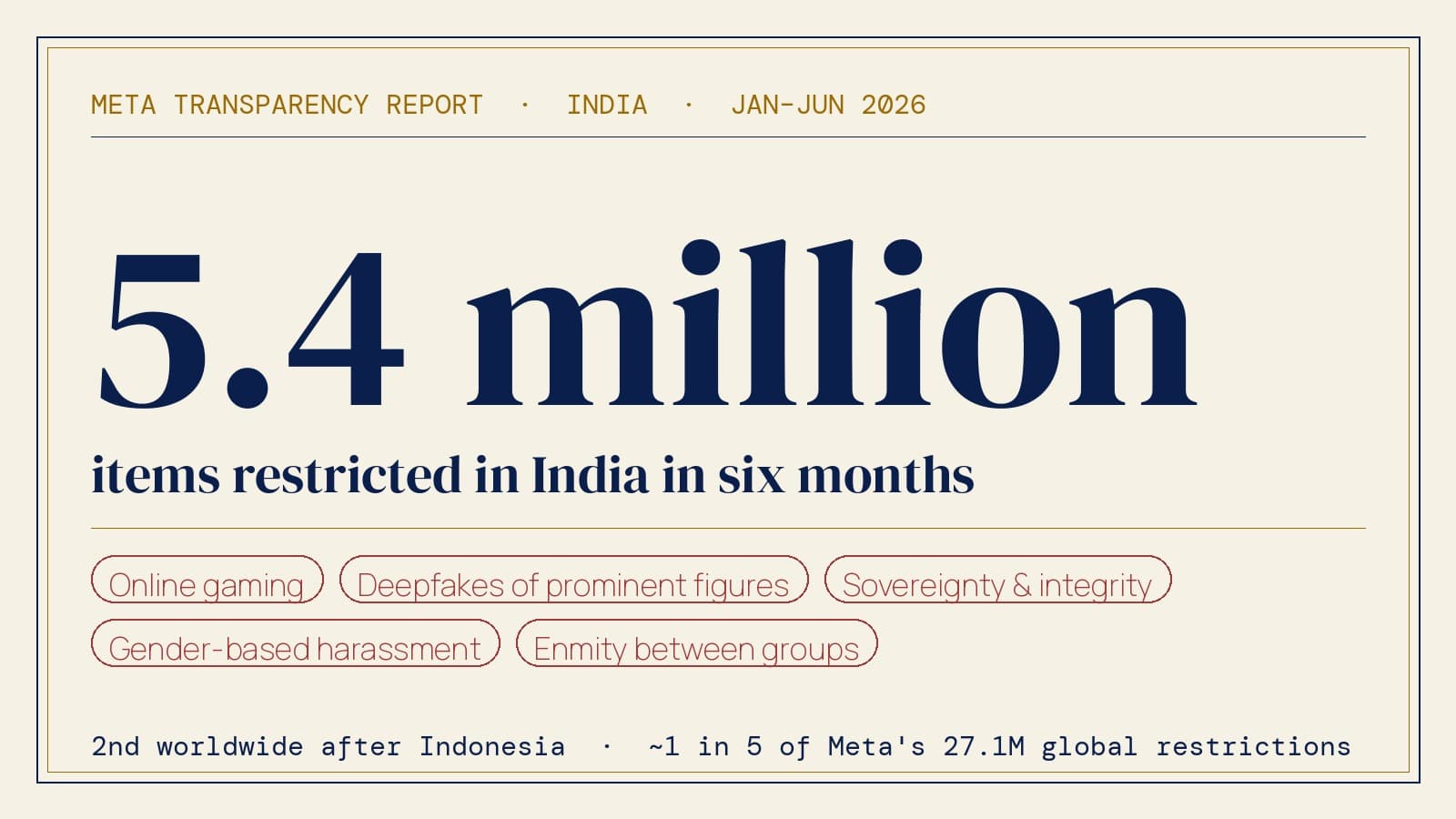
Online gaming, deepfakes of prominent figures, threats to sovereignty and integrity, gender-based harassment and promoting enmity between groups drove Meta to restrict over 5.4 million items in India in January–June 2026. Meta said most were automated restrictions, including identical copies, required by the amended IT Rules. India has 403 million Facebook users and 481 million on Instagram.
New Delhi, India : Content tied to online gaming, deepfakes of prominent figures, threats to India's sovereignty and integrity, gender-based harassment and promoting enmity between groups drove Meta to restrict access to more than 5.4 million items in India between January and June 2026, according to the company's latest Content Restrictions Report.
The figure makes India the second-largest source of such restrictions on Facebook and Instagram worldwide, after Indonesia.
Gaming, Deepfakes and Sovereignty Threats
Meta said the restricted items in India relate to alleged unlawful content in five areas:
- online gaming
- synthetically generated content depicting prominent figures
- threats to the sovereignty and integrity of India
- gender-based harassment
- promoting enmity between groups
The company said the "large majority" were cases where it was "obligated to proactively restrict content, including instances of restricting 100% identical copies of content, at scale and in country, based on local law requirements such as the amended Information Technology Rules."
"Due to the unprecedented nature of this effort, we continue to test and refine our implementation of these measures," Meta said.
It added that it restricted over 20,000 further items on Threads, which are counted separately from the country total.
The Scale in Context
India had 1,114.17 million internet subscribers at the end of June 2026, according to the Telecom Regulatory Authority of India (TRAI), up from 1,092.79 million in March.
That user base spans one of the world's most diverse populations.
The 2011 Census recorded 19,569 raw mother tongue returns, grouped into 121 languages, including the 22 scheduled languages in the Eighth Schedule of the Constitution.
The same Census counted six major religious communities:
- Hindu (79.8%)
- Muslim (14.2%)
- Christian (2.3%)
- Sikh (1.7%)
- Buddhist (0.7%)
- Jain (0.4%)
And 705 ethnic groups notified as Scheduled Tribes, numbering 104 million people.
Content moderation across this many languages and communities means categories such as promoting enmity between groups and threats to sovereignty apply to a very large and varied body of posts.
Who Sends the Requests
According to the report, the restrictions followed reports from MeitY, MIB, I4C and state law enforcement agencies, as well as enforcement through automated systems and other legal requests.
Meta said I4C reports were issued under Section 79(3)(b) of the Information Technology Act, 2000.
I4C, under the Ministry of Home Affairs, runs the Sahyog portal, through which authorised agencies send Section 79(3)(b) notices to platforms.
The Karnataka High Court upheld the portal on September 24, 2025, dismissing a challenge by X Corp.
The Legal Framework
MeitY notified amendments to the IT Rules, 2021 on February 10, 2026, which came into force on February 20, 2026.
The amendments:
- require platforms to prevent unlawful synthetically generated information, including deepfakes, and to label permitted AI-generated content with visible labels and embedded metadata
- cut the deadline for removing unlawful content after a court order or a reasoned government intimation from 36 hours to three hours
- change Rule 4(4) so that significant social media intermediaries must deploy automated tools to proactively identify content exactly identical to content already removed under Rule 3(1)(d), replacing the earlier requirement to "endeavour" to do so
The online gaming category follows the Promotion and Regulation of Online Gaming Act, 2025, which received Presidential assent on August 22, 2025 and bans online money games.
The Act and its rules came into force on May 1, 2026.
User Notice
Meta said that in most countries it now tells users which state authority requested a restriction.
India is among the countries excluded from this practice, along with Mexico, Costa Rica, Colombia, Argentina, Brazil and Hong Kong, which Meta attributed "primarily" to legal obligations and regulatory considerations.
The company directs users to a Help Centre article explaining what content is prohibited under the IT Rules amendments and how to appeal or raise a grievance.
It's set for Internet Governance with Platform "Facebook".
The source field will read "Meta Transparency Center (Content Restrictions Based on Local Law, H1 2026)", and the body has no references or Source line.